Showing posts with label art. Show all posts

Thursday, July 3, 2014

Kara Walker's "A Subtlety"

There has been a lot of talk recently about Kara Walker's new exhibit in Brooklyn, called "A Subtlety."  Actually, the official title of the piece is, "A Subtlety, or the Marvelous Sugar Baby an Homage to the unpaid and overworked Artisans who have refined our Sweet tastes from the cane fields to the Kitchens of the New World on the Occasion of the demolition of the Domino Sugar Refining Plant." But in a word (or two), I'd call it simply astounding.  The work comments broadly on race (and specifically on African Americans' experiences in America/the Caribbean).  It speaks to history near and far, and plays with contrasts of color, scale, and thought.  It also intertwines olfactory experience with artistic concept in a way that I haven't seen before: the mesmerizingly sweet smell of molasses in the air somehow envelops, but also clashes against, the harsh acidity of the work's content matter.

As with all works of art, the viewer has the choice of interacting with its subject on a very superficial or meaningful level.  This is a very rich, multilayered piece of work that contains a great deal of symbolism, some of it subtle, some of it overt.  Not surprising, given the weight (and presentation) of the subject matter considered here, there has been some controversy surrounding people's responses to the exhibit (some Instagram photos, for example).  In a pointed critique, Dr. Nicholas Powers, Associate Professor of English at SUNY Westbury, suggested that, in their interactions with the piece, many visitors were (consciously or unconsciously), "...recreating the very racism this art is supposed to critique."


"questionable acts" were demonstrated by staff members as well.

It's really amazing living in a city in which we are all constantly coming together (on the subway, in the market, at the park, at art exhibits, etc.).  At the same time, it's disappointing to be reminded that we remain a divided community in many ways, and that these divisions are based in part on race, which often leads to very different experiences as we move throughout the city and life.  But this is not, nor should it be, the sole focus of this installation, which is truly monumental in scale and concept.  "A Subtlety" is a very complex piece of art that requires much thought and introspection.  With this work, Kara Walker has offered the viewer an opportunity to learn more about themselves, history, and society.  I've visited the installation twice; I was and continue to be very moved.

For more information about this piece, I recommend:

NPR interview
NY Times article
New Yorker article
a piece about the experience of African Americans who have visited the work
an interview with Kara Walker by ArtNet

... and a truly wonderful (and informative) video from a live broadcast interview with Kara Walker that is available from the NY Public Library.


Sunday, April 27, 2014

All that Jazz

I had been neglecting my passion for live jazz (listening, not playing) for far too long.  So when I found myself walking past the legendary (and sometimes touristy) Blue Note last Tuesday night, and realized that the renowned bassist Stanley Clarke was playing, I just had to stop in.  Sure, the show was half over, and I had to stand way in the back, but it was worth it!

At the Blue Note in the West Village

Still, when the show ended, I wanted to hear more.  And so, on my way home when I heard some familiar jazz tunes streaming out onto the street from the Bar Next Door, and met the drummer, Rudy Royston, who was playing with the Jon Irabagon Trio that night, of course I had to stay for their next set.  And was it an amazing set!  Rudy had a solo that would make anyone want to become a drummer.  What's more, the Bar Next Door is a lovely little restaurant/bar/jazz house; in my opinion, it's one of the best places in town to hear local jazz artists at their best in a cozy, intimate setting.  I'd go so far as to say it's a bit of a hidden gem.  After the set ended I had a chance to talk to a few of the musicians, and get a quick introductory bass lesson from the ever kind and exceptionally talented Yasushi Nakamura (check that off my to-do list!).

The Bar Next Door

From here I traveled with my new friend, Klemens Marktl, who had just completed a few nights at Smalls with the Don Friedman Trio.  Off we went to my a third (but who's counting?) and final jazz show of the night at Whynot Jazz Room where Klemens' friends were playing (and where, oddly enough, I had planned to meet a friend for coffee earlier that evening in their upstairs coffee shop, Whynot Coffee & Wine).  When we arrived, the formal set was just wrapping up, and the trio opened up the show to musicians in the audience.  I wholeheartedly recommend these types of jam sessions to anyone who likes jazz, because they show just how dynamic these players really are, and just how much fun they have with their craft.  The musicians riffed and improvised, one playing off the other.  The music was playful, whimsical, and even soulful.  Several of the musicians hopped from one instrument to the next, and every song they played sounded as good or better than the last.  There were smiles, laughs, nods, cheers, yelps, shouts, and claps the whole way through. 

Whynot Jazz Room

The air was buzzing when the bar finally closed and we stepped out onto the now quiet streets of the West Village.  Another musician (a bassist) joined us while we chatted on the sidewalk; he told us about the amazing gig he had just come from.  The group decided to go on to another bar, but I decided to go home, with a warm smile, full heart, and a little more jazz in my soul.


Saturday, January 4, 2014

New Year's Eve trip to The Cloisters

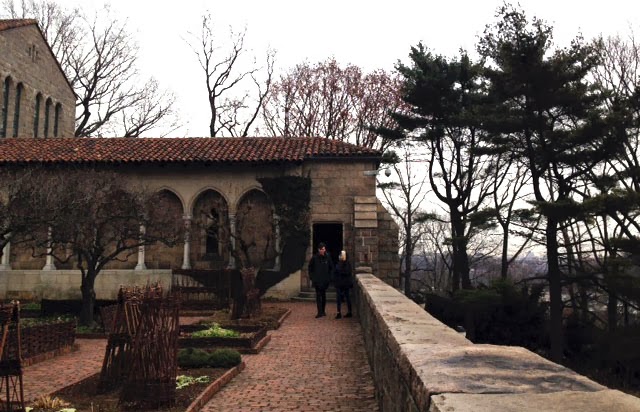
The Cloisters is a museum located on 4 acres of land overlooking the Hudson River in northern Manhattan.  A branch of The Metropolitan Museum of Art, this museum is unlike any other that I've visited, as all of the exterior architecture as well as the interior works of art are reflective of medieval Europe (actually, now that I think of it, the Museum of the Middle Ages of Gorizia, which is absolutely amazing, is somewhat similar).  The Cloisters are a collection of buildings that incorporate aspects of several different medieval buildings.  Many elements, both structural and decorative, from medieval cloisters (e.g.,  Saint-Michel-de-Cuxa, Saint-Guilhem-le-Désert, Trie-sur-Baïse, Froville) have been incorporated into the larger building, all of which is laid out in chronological order with the oldest styles and architecture presented first.  Click here for a map of the museum.

The museum was opened to the public in 1938, and has a rich history, including the preservation of land directly across from The Cloisters on the other side of the Hudson River in New Jersey, which has secured the museum's pristine views of the NJ Palisades.  As you might imagine, the Cloisters are very peaceful.  It's a wonderful place for reflection and contemplation.  The collection of artwork housed within is as spectacular and vast as the setting of the Cloisters itself.  It was lovely spending the last day of 2013 among such beauty and history.  It was the perfect location to gain the perspective and peace of mind that this time of year calls for.


Below, an apse constructed in Spain around the 12th century.  It is originally from the San Martín church at Fuentidueña and is on "permanent loan" from the Spanish government.  The dome is decorated with a Catalan fresco of the Virgin Mary and Child; a 12th century wooden crucifix, also from Spain, hangs from the arch. 


Below, the Gothic Chapel, a modern structure built in the Gothic style, which houses the carved sculptures (effigies) and tombs of royal and noble figures from France and Spain (~ 13th - 14th century).  The stained-glass windows are from 14th century Austria.

 
One of the medieval inspired gardens ("Bonnefont").

View of the Palisades in the distance.

Below, is a cloister from the Carmelite convent formally located in Trie-sur-Baïse (south-western France, near Toulouse).  Elements of this structure date back to the late 15th century.


The museum houses several small scales pieces in a gallery called the Treasury.  From the curator of the exhibit: "Every medieval church had a treasury in which its most important objects were kept.  For this reason, the Cloisters Treasury is very much in keeping with tradition." Below is an example of one of the treasures on display, a triptych depicting scenes from the Passion of Christ (1494).


Below, through the archway hangs the first tapestry in a series of seven called The Unicorn Tapestries created in the Netherlands between 1495 and 1505.  They are woven of wool, silk, silver, and gold.  The tapestries depict a story in which an elusive magical unicorn is hunted and finally tamed, willingly.  The unicorn is thought to symbolize love.


The Unicorn in Captivity

Below, the last sun rays of 2013 shine through the trees on the grounds of the Cloisters.


For more information about the exhibits in the museum I recommend reading, "A Walk Through the Cloisters," by Bonnie Young.

Tuesday, October 8, 2013

The Affordable Art Fair, Banksy, and the High Line

I had been waiting months for the Affordable Art Fair to arrive in the city, and finally the day was here!


Their opening gala was on Wednesday night.  And interestingly, the art fair coincided with the opening days of Banksy's month-long show on the streets of NYC.  Banksy is a well-known, but still anonymous, graffiti artist/political activist from England who has been on the scene since the 1990s.  His pieces sell for hundreds of thousands of dollars.  Banksy's works are at times mildly subversive, but also a bit cheeky, and he is after all an artist.  So I had to wonder if it was merely a coincidence that the second piece in his show appeared the morning after the opening gala of the art fair, only a block or so away from the venue where the gala/fair was being held.  You see, because Banksy's art is (technically) illegal, in that it is (technically) graffiti, he creates each piece in the middle of the night and it's not found until the next morning when all of NY (well not all of NY) runs around in a frenzy trying to find its location, aided by hints provided by Banksy on his website and Twitter.  So, the timeline here is very curious... on the same night that the art fair held its opening gala, Banksy was also in the area creating the second installation of his show.  Coincidence?  How far of a stretch would it be to imagine Banksy at the gala, or perhaps even involved in the fair in a more official capacity?  (Every anonymous graffiti artist needs a proper cover.)  Or... was this second piece just a strategically well-positioned work aimed at maximizing his visibility, given its proximity to the art fair, Chelsea galleries, and the High Line?  Will we ever know?  Will we ever solve this mystery?

Well, either way, I was eager to see Banksy's second installation.  It's a playful piece that reads, "This is my New York accent... normally I write like this." It uses a style of tagging that originated in NYC in the 1970s and has since spread throughout the world.  Many New Yorkers appreciated Banksy's nod to local culture, especially so early on in his month-long residency.  I've even heard some people go so far as to say the piece is iconic.


Perhaps Banksy was hoping the work would be better received than his initial piece, and left untouched, due to this gesture, but no such luck...  It was defaced quite quickly, which is de rigueur for this type of work, and sadly, by the time I viewed it on Saturday you could barely make out the original writing.


From Banksy I moved on to the art fair... and in 3 words, it was wonderful.  The objective of the fair, which has been holding shows since 1999, is to gather a number of galleries, locally and from around the world, in one place and to offer the best of their collections to the public.  I just love the idea of bringing art to the people, and at a price that many people can afford -- there were several pieces under $50, but of course they also had absolutely wonderfully breathtakingly beautiful pieces for up to $10,000.  The fair showcased many types of art, including ceramics, photography, sculpture, painting, and print making.  But the highlight of the event was that many of the artists whose works were on display were also present at the show.  It's really quite amazing to be able to talk to the artists in person about their work, their process, their inspiration, their interpretation of their pieces, and what they like best about their work.  Some lucky viewers were also able to watch a few artists create their pieces as part of the show, which were then sold at the fair.  It was all very exciting. 


I was so taken by it all that I purchased a small print by Chad Kouri on the spot.  Of course this was only after I asked him to give me his opinion about which print he liked best.  Fortunately, our thoughts were aligned on this matter!


There was only one way to close out the evening's events, and that was with a stroll on the High Line.  This was the perfect setting to reflect on art, what it is, who creates it, where we find it (on the streets, in the galleries, in the parks, in the skylines of our cities), and why we need it.  The night felt like it was plucked from late summer, with its damp humid air and temperatures in the low 70s.  What a treat it all was.

Thursday, October 3, 2013

Fall for Dance Festival

I was thrilled to accompany a friend last night to the Fall for Dance Festival at City Center.  This is the 10 year anniversary of the festival, and last night's performances were absolutely brilliant.  A few months back one of my colleagues mentioned that the festival is the hottest deal in town if you are interested in seeing works by some of the best dance companies in the world.  And she was so right.  Tickets cost $15 (plus processing fees), but you have to buy them as soon as they go on sale, because they are not available for very long.  I missed the ticket sale frenzy, but I was lucky enough to have a friend with an extra ticket, and I jumped (well, maybe I didn't jump, but it was certainly more than a relevé) at the chance to join her.  

There were four performances.  The show opened with SOUNDspace, a work by Dorrance Dance, a new and highly acclaimed company of tap dancers.  This performance was music in the form of dance, if you can imagine.  Their combination of dance with a rhythmic, at times syncopated, sound resembles Savion Glover's style.  I found a video with excerpts from earlier performances.  But the videos don't do them justice.  This group really brought the house down (with 'da funk and 'da noise).  They were absolutely amazing and their performance received a standing ovation. 

The second work by Doug Elkins Choreography, Etc playfully incorporated music by James Brown, Marvin Gaye, and Amy Winehouse, cleverly using the lyrics to underscore the storyline portrayed by the 2 couples on stage -- a storyline that harked back to Shakespeare's Othello.  This was a moving and simultaneously unsettling performance.  In the third piece, by The Royal Ballet, the two dancers were joined on the stage by a pianist and cellist.  This performance was grace, strength, and masterful technique incarnate.

But the most anticipated performance of the night was arguably The Rite of Spring, by the Martha Graham Dance Company, since this piece is celebrating its return to the stage after a 20 year hiatus.  I loved this performance, whereas my friend was not so impressed.  I see her point.  The work is modern and a bit grandiose, but this is the company's style -- they have a strong aesthetic and a unique manner of dancing.  Perhaps a NY Times review of the 1984 production put it best, "it is a work of disturbing and modern urban tension."  The musical score, written 100 years ago by Igor Stravinsky, provides a lot of this tension.  Together with the spartan set, the dramatic music, and the exaggerated choreography, it was all very cerebral and it reminded me of a time when there was a great deal of focus on the workings of the unconscious psyche.  Themes of aggression, power, fate, the unpredictable nature of life, personal vulnerability, individual sacrifice, and the role of society were all on display in the most theatrical of ways, exposed perhaps by the stark nature of the performance itself. It was, in a word, impressive.


Sunday, September 22, 2013

Morningside Lights Annual Lantern Parade

After having a lovely dinner with a few friends this past weekend we walked outside to find a wonderful event, Morningside Lights, going on in the park. This illuminated parade of handmade papier-mâché lanterns was the culmination of a week-long collaboration between community members and artists from the Processional Arts Workshop.  The program included several seminars where attendees learned how to make luminescent lanterns as well as home-made instruments, both of which were beautifully featured in the night parade. Pretty fantastic if you ask me.